Resting the chin on a hand is one of the most common poses in portrait drawing, and one of the easiest to get slightly wrong. The hand has to carry real weight, the head tilts into it, and the arm becomes a column that runs down to a surface you may not even show. This set collects ten photos of the pose from different angles, ages and settings, with notes on what to look for in each.
What actually happens in the pose
- The hand takes weight. The head leans into it, so the cheek or jaw compresses slightly where they meet. A hand that only touches the face looks posed rather than resting.
- The wrist bends. Usually the back of the hand faces away from the face, with the fingers curling under the jaw or along the cheek.
- The forearm becomes a support. It runs roughly upright from the chin to the elbow, and the elbow sits on something: a table, a knee, the back of a chair.
- The supporting shoulder rises. Lifting the forearm pushes that shoulder up and toward the face, which tilts the whole line of the shoulders.
- The head tilts toward the hand. Even a small tilt changes the angle of the eyes and mouth, so check those lines against the photo.
The reference set

1. Front view, one hand. The classic version. Notice how the fingers curl along the jaw rather than sitting flat, and how the hand partly hides the line of the chin.

2. Hand under the chin, upright posture. The back stays straight here, so the hand steadies the head more than it carries it. Compare the space between hand and neck with the more relaxed poses below.
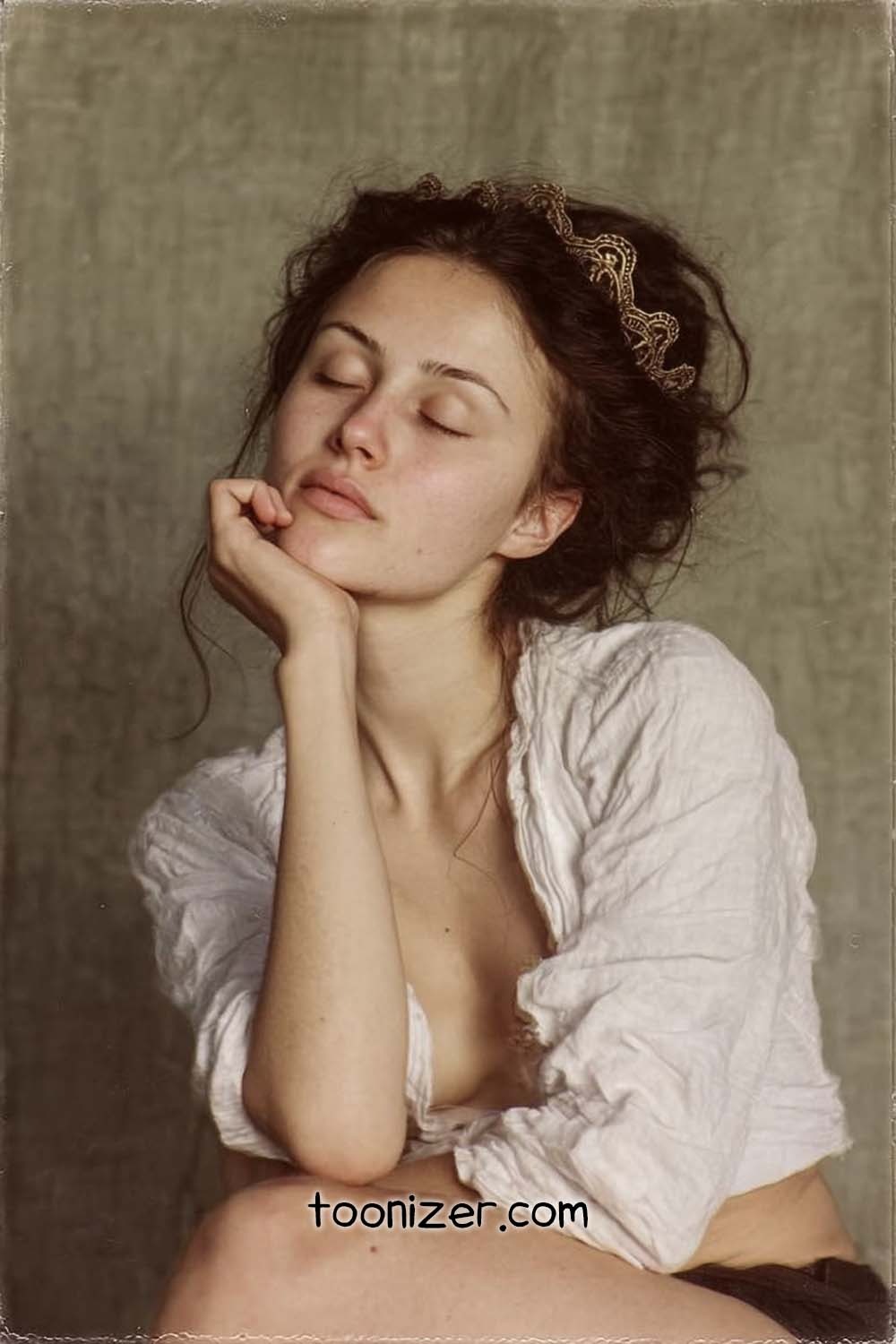
3. Eyes closed. With the eyes closed, the expression depends on the brows and the corners of the mouth. Good practice for drawing calm without making the face look blank.

4. Both hands. Two hands make a small platform under the chin. Watch how the fingers overlap, and how both elbows need something to rest on in front of her.

5. Looking away, at a table. The gaze goes to the side while the hand stays in place. The head turns toward a three-quarter view on top of a frontal arm, a useful exercise in mixing angles.

6. Café table. A relaxed, everyday version. Notice how little of the hand is visible from the front and how the sleeve shapes the wrist.

7. With glasses. Glasses add a second set of lines that has to follow the head tilt. Check that the frames sit at the same angle as the eyes.

8. Seated on a bench, older subject. Age changes the hand as much as the face: more visible joints and tendons, looser skin around the wrist. The wider frame also shows where the elbow rests.

9. Full figure, seated on the floor. Here the arm is supported low, close to the body. Useful for seeing how the pose connects through the whole figure, not just the head and hand.

10. Standing and leaning. Without a table, the arm finds another support, in this case a post. The weight shifts into the hips and the free arm hangs loose.
Common mistakes
- A hand that is too small. A hand is roughly as long as the face from chin to hairline. Next to the face, an undersized hand stands out quickly.
- No support under the elbow. If the arm has nothing to rest on, the pose looks like it could not hold for more than a second.
- Level shoulders. The supporting shoulder rises. Drawing both at the same height flattens the pose.
- A gap between hand and face. Unless the photo shows one, keep the contact. The point of the pose is that the head is resting.
Practice ideas
- Make two-minute gesture sketches of all ten, following only the line from the head down through the arm to the point of support.
- Pick one photo and draw just the hand and jaw, large, until the overlap reads clearly.
- Draw two of the photos side by side in the same style, to see how much the camera angle changes the shapes.
For more poses, see Same Model, Different Poses and the rest of the Drawing References category. To see how a pose reads in a cartoon style, you can also run your own photo through the Toonizer generator.
0 Comments